Publicity Contact: Giselle Roig
212.782.8609 /
groig@randomhouse.com
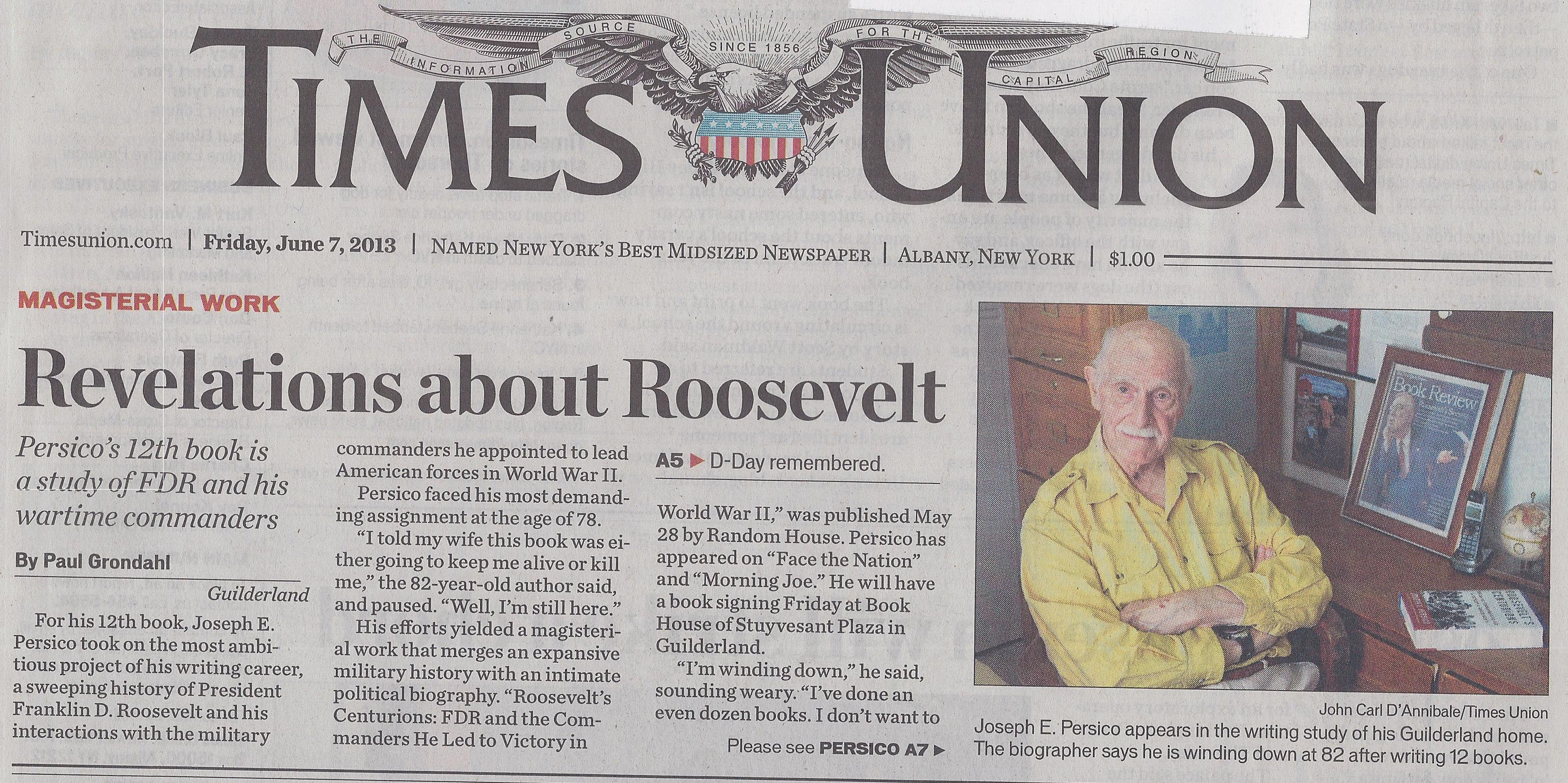

NEWS ON JOSEPH E. PERSICO’S BOOKS
Joseph E. Persico’s latest,
ROOSEVELT’S CENTURIONS: FDR and the Commanders He Led to Victory in World War II, has been chosen by the History and Military book clubs as their main selection.
On May 28, 2013, Random House will publish
New York Times best selling author Joseph E. Persico's latest work:
ROOSEVELT'S CENTURIONS
FDR and the Commanders He Led to Victory
in Word War II
Interestingly, his appointees
stayed in place from the first to the last day of the war, while
Winston Churchill fired generals and admirals left and right.
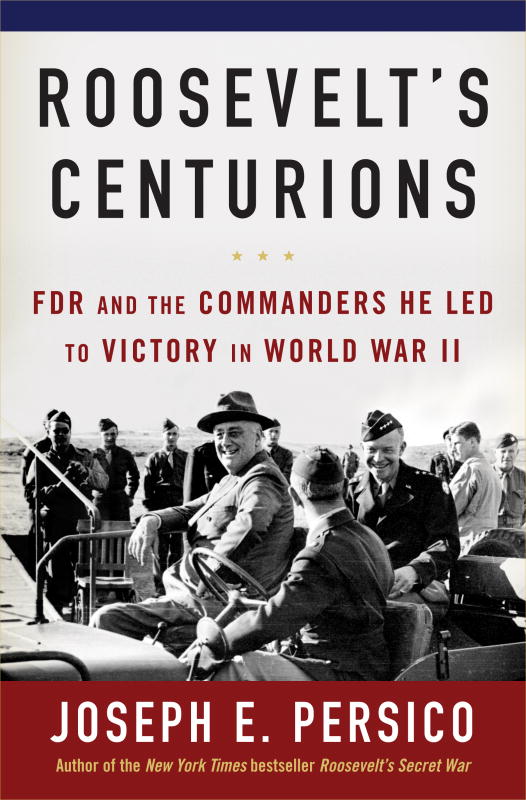 ROOSEVELT'S CENTURIONS
FDR and the Commanders He Led to Victory
in World War II
World War II, the largest and most consequential conflict in human history, was the ultimate test of presidential leadership. In Roosevelt's Centurions, distinguished historian Joseph E. Persico shows how President Franklin D. Roosevelt and a cadre of handpicked commanders aced that test, guiding America's armed forces to a smashing victory that was anything but foreordained.
Having remade the American economy in the wake of an unprecedented financial collapse, Roosevelt had assured his place in history even before the attack on Pearl Harbor. But America's entry into the fight against the Axis compelled him to focus his formidable political skills on an even more monumental task: assembling and managing a team of proud and sometimes prickly warriors who could execute a plan for victory. Taking us inside the Allied war councils, Persico shows how "Dr. Win the War"—as FDR now styled himself—selected his commanders, brokered strategy with contentious allies, and rallied public support for the war effort. Though often derided for his haphazard management style, the Roosevelt who emerges in these pages is a master delegator with a supple strategic mind who is not shy about overruling the wishes of his military advisors.
To complement his portrayal of an active and engaged FDR, Persico offers indelible portraits of some of the outsize figures of World War II, the men who roused the "sleeping giant" that defeated the Axis war machine: the dutiful yet independent-minded Army Chief George C. Marshall, charged with revitalizing a force whose troops trained with broomsticks for rifles and eggs for hand grenades; Dwight Eisenhower, the genial Kansan elevated from obscurity to command the greatest fighting force ever assembled; and the mercurial, vainglorious Douglas MacArthur. Here too are the less widely celebrated military leaders whose contributions were just as critical: the irascible, dictatorial Navy Chief Ernest King; acerbic China expert "Vinegar" Joe Stilwell; and Hap Arnold, an early and zealous proponent of the gospel of air power and its potential to revolutionize modern warfare.
What are the qualities we look for in a commander-in-chief? In an era of renewed conflict when Americans are again confronting the questions that FDR faced—about the nature and exercise of global power—Roosevelt's Centurions is a timely and revealing examination of what it takes to be a war leader in a messy, complicated, and tumultuous democracy.
Advance Praise for Roosevelt’s Centurions
"When I was a boy growing up in the South Bronx, my heroes were Roosevelt's Centurions. As a soldier for thirty-five years, I made them my mentors and models. These men were human, fallible, and occasionally vain, but we were certainly blessed to have such Americans leading the Greatest Generation during the world's greatest conflict. Of course the greatest centurion of all was FDR himself, who knew how to lead his commanders, stroke their egos, and get the best from them, yet never leaving any doubt as to who was commander in chief. Joe Persico, my valued collaborator on my memoirs, has brought his formidable talents to bear to bring the Centurions to life. He is at the top of his game in this defining classic."Colin L. Powell, General, USA (Retired)
" Joseph E. Persico has done it again! Roosevelt’s Centurions is a riveting, analytic recounting of FDR as top World War II strategist. Nobody before has written on Roosevelt as talent scout with the brilliant insight of Persico. I found Persico’s elucidation of the FDR-George Marshall relationship marvelous. A grand book for the ages!"
Douglas Brinkley, author of Cronkite
"Benefiting from his years of studying Franklin Roosevelt and his times, Joseph Persico has brought us a briskly-paced story with much wisdom and new insights on FDR, his military liege men, World War II and political and military leadership."
Michael Beschloss, author of Presidential Courage
"To a remarkable degree we inhabit a world originated by Franklin D Roosevelt - on World War II battlefields, in the gilded halls of diplomacy; above all, inside FDR's fertile, inscrutable imagination. Joe Persico brings all this to life with stunning originality, insight, and narrative drive. Familiar names- Marshall, Patton, Eisenhower, Churchill - are here rescued from caricature. So are the strategic and political decisions that inform today's debate over civil liberties in wartime. The last word on Roosevelt's war, it's safe to say, will never be written. But it's hard to imagine anyone writing any better ones than these."
Richard Norton Smith, author of THE COLONEL: The Life and Legend
of
Robert R. McCormick, 1880-1955
"With rigorous research, a fine eye for detail, and an entertaining ability to recount history, Joe Persico deftly portrays the men behind the man, in addition to skillfully presenting the star himself, FDR, as recruiter-in-chief. A must-read for Americans concerned about war leadership then and now."
Evan Thomas, author of Ike's Bluff: President Eisenhower's Secret Struggle to Save the World
"Whatever his flaws, Franklin Roosevelt had an eye for talent, according to this sweeping, top-down account of 1939–45 from the point of view of FDR, his cabinet and his leading generals and admirals.. . . Long wars demand long books, but these are 550 pages of lively prose by a good writer who knows his subject. . . . A fine, straightforward politics-and-great-men history."
Kirkus Reviews
Excerpts of Reviews of Books By Joseph E. Persico
FRANKLIN AND LUCY: FDR and the Remarkable Women in His LifeRandom House
“Persico’s exploration of FDR’s emotional life is fascinating.”
USA Today
“Persico . . . understands that Lucy Mercer helped FDR awaken his capacity for love and
compassion, and thus helped him become the man to whom the nation will be eternally in debt.”
Washington Post Book World
NUREMBERG: Infamy on Trial
The Viking Press
“This work will probably command, and deserves,
a wider readership than any of its predecessors. Every generation
needs a book like this.”
Washington Post
“It is not often that a book works at once
as historical tract, morality play and crime thriller. This one
does.”
Philadelphia Inquirer
Random House
“My American Journey is an endearing and well written book,
written with Joseph E. Persico, the author of several fine
biographies.”
New York Times
“Ably written with Joseph E. Persico,
My
American Journey finally fleshes out for us who, indeed, is Colin
Powell.”
USA Today
McGraw Hill
“A distinguished and compellingly readable
biography. Persico brings to Murrow the intellectual discipline of
the historian, the polished and memorable prose of the accomplished
biographer.”
Los Angeles Times
“Written with insight and perceptiveness. Mr.
Persico is an able reporter and a fine story teller whose taste, tact
and skill have produced a memorable biography.”
New York Times
Simon and Schuster
“Persico tells his story brilliantly. No one has
written a book like this about Nelson Rockefeller before.”
New York Times
Viking Press
“Those of us who devour spy stories like cashew
nuts are in Mr. Persico’s debt. Brilliantly researched and cleverly
told.”
Washington Post
“A masterwork. It is surely the most vivid
testimonial yet to the OSS. This is heart pounding stuff.”
Philadelphia Enquirer
Viking Press
“This vivid, absorbing action-packed narrative
of the greatest battle ever fought in North America practically
transports the reader onto the scene, causing sweating palms and a
sense of looming danger.”
Library Journal
“My Enemy, My Brother is an eloquent documentary,
forming the facts into a mosaic that shows the terribleness of war.”
New York Times
Crown
“Mr. Persico tells his story better than
most writers who in recent years have been dabbling in World War
II adventure tales. He has a certain amount of sympathy for the
human condition . . . the writing is crisp, and the plot moves
very well”
New York Times
“ A neatly built thriller, and it also
has something worthwhile to say.”
Washington Post
Joseph E. Persico Historian/Biographer
His latest book is Roosevelt's Centurions: FDR and the Commanders He Led to Victory in World War II, published by Random House and on sale as of May 28, 2013.
Prior to beginning his career as a historian and biographer, Joseph E. Persico was chief speechwriter for New York governor and later U.S. vice president, Nelson A. Rockefeller.
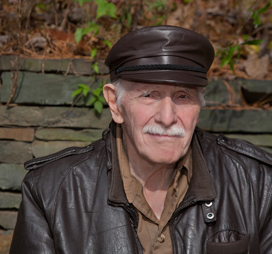 Of Persico's writing career, Eric Sevaried described his
Edward
R. Murrow: An American Original as "the definitive" biography of
the broadcast pioneer. The New York Times said of Persico's
The
Imperial Rockefeller, "No one has written a book like this about
Nelson Rockefeller before." His Nuremberg: Infamy on Trial was
described by the broadcast journalist, Howard K. Smith, as "Simply
the best account of the trial." This book was adapted by
Turner
Network Television as a miniseries that won two Emmy awards. Persico was the collaborator on former Secretary of State Colin
Powell's autobiography, My American Journey which remained twenty
weeks on the New York Times best seller list. His
Roosevelt's Secret
War: FDR and World War II Espionage also reached the best seller list
and was chosen as one of the notable books of the year. His,
Eleventh
Month, Eleventh Day, Eleventh Hour, on Armistice Day, World
War I, has been described by historian, Richard Norton Smith as,
"The single finest work I have read on the Great War." The
Washington Post's Book World said of his Franklin and Lucy:
President Roosevelt, Mrs. Rutherfurd, "Persico... understands
that Lucy Mercer helped FDR awaken his capacity for love and
compassion, and thus helped him become the man to whom the nation
will be eternally in debt."
Of Persico's writing career, Eric Sevaried described his
Edward
R. Murrow: An American Original as "the definitive" biography of
the broadcast pioneer. The New York Times said of Persico's
The
Imperial Rockefeller, "No one has written a book like this about
Nelson Rockefeller before." His Nuremberg: Infamy on Trial was
described by the broadcast journalist, Howard K. Smith, as "Simply
the best account of the trial." This book was adapted by
Turner
Network Television as a miniseries that won two Emmy awards. Persico was the collaborator on former Secretary of State Colin
Powell's autobiography, My American Journey which remained twenty
weeks on the New York Times best seller list. His
Roosevelt's Secret
War: FDR and World War II Espionage also reached the best seller list
and was chosen as one of the notable books of the year. His,
Eleventh
Month, Eleventh Day, Eleventh Hour, on Armistice Day, World
War I, has been described by historian, Richard Norton Smith as,
"The single finest work I have read on the Great War." The
Washington Post's Book World said of his Franklin and Lucy:
President Roosevelt, Mrs. Rutherfurd, "Persico... understands
that Lucy Mercer helped FDR awaken his capacity for love and
compassion, and thus helped him become the man to whom the nation
will be eternally in debt."
His articles have been published in American Heritage Magazine and the Military History Quarterly. He is a frequent reviewer for the New York Times Book Review and the Washington Post Book World and is a commentator on several PBS and History Channel documentaries.
Find me on Facebook